
Case Study: Moynihan Train Hall
The Story
In 2018, Public Art Fund was engaged by Empire State Development and Vornado Realty Trust to lead the development of an ambitious art program for the new Moynihan Train Hall. The aim was to express the distinct spirit of the busiest train hall in the Western Hemisphere as well as its rich relationship to New York City’s past, present and future. Working with the Moynihan Train Hall Art Program Selection Committee, Public Art Fund invited a series of artists to develop site-specific proposals, from which the Art Selection Committee chose to commission permanent installations by three artists.
Opened in January 2021, Moynihan Train Hall set a new standard for contemporary public art in a landmark civic space. The three unprecedented site-specific art installations by Stan Douglas, artist duo Elmgreen & Dragset, and Kehinde Wiley serve as a testament to New York’s creativity, diversity, and richly layered heritage. Offering the public a fresh perspective on the history and grandeur of the original Pennsylvania Station and James A. Farley Post Office, the artworks bring a sense of wonder and humanity to these public spaces.
Impact and Highlights
- The 255,000 square foot train hall is the busiest transportation hub in the Western hemisphere, serving more than 700,000 passengers daily.
- Open House New York awarded Moynihan Train Hall with the 2022 Open City Award.
- The Municipal Art Society of New York selected the transportation hub as the Best New Infrastructure winner in its 2022 MASterworks Award program, which honors projects that make a significant impact on New York City’s built environment.
- Public Art Fund partnered with artists to navigate the challenges of working at unprecedented scale, working in new media or using new methods, and installing their work in an extremely active construction site. With many different building trades sharing tight quarters and an aggressive schedule—all at the height of the COVID-19 pandemic – Public Art Fund’s project management was critical for the art program’s success and on-time delivery.
- Using very different imagery, forms and materials, each commission tells a unique story about Moynihan Train Hall and NYC, creating an authentic and resonant sense of place.
- Each commission responds to the specific architectural and programmatic attributes of this complex site, an adaptive reuse of an existing building.
Project Timeline, 2018–2021
Planning and Strategy
– Site-specific research begins
– Stakeholders engaged
– Creative vision developed
Research and Development
– Proposed artists presented to selection comittee
Commissioning
– Commissions awarded
– Initial artist proposals refined
Implementation
– Installation (in midst of Covid-19 pandemic)
– Signage and promotional materials created
Launch & Project Close Out
– Press and communications outreach
– Interpretive content provided
– Maintenance manual submitted
Artists and Artworks
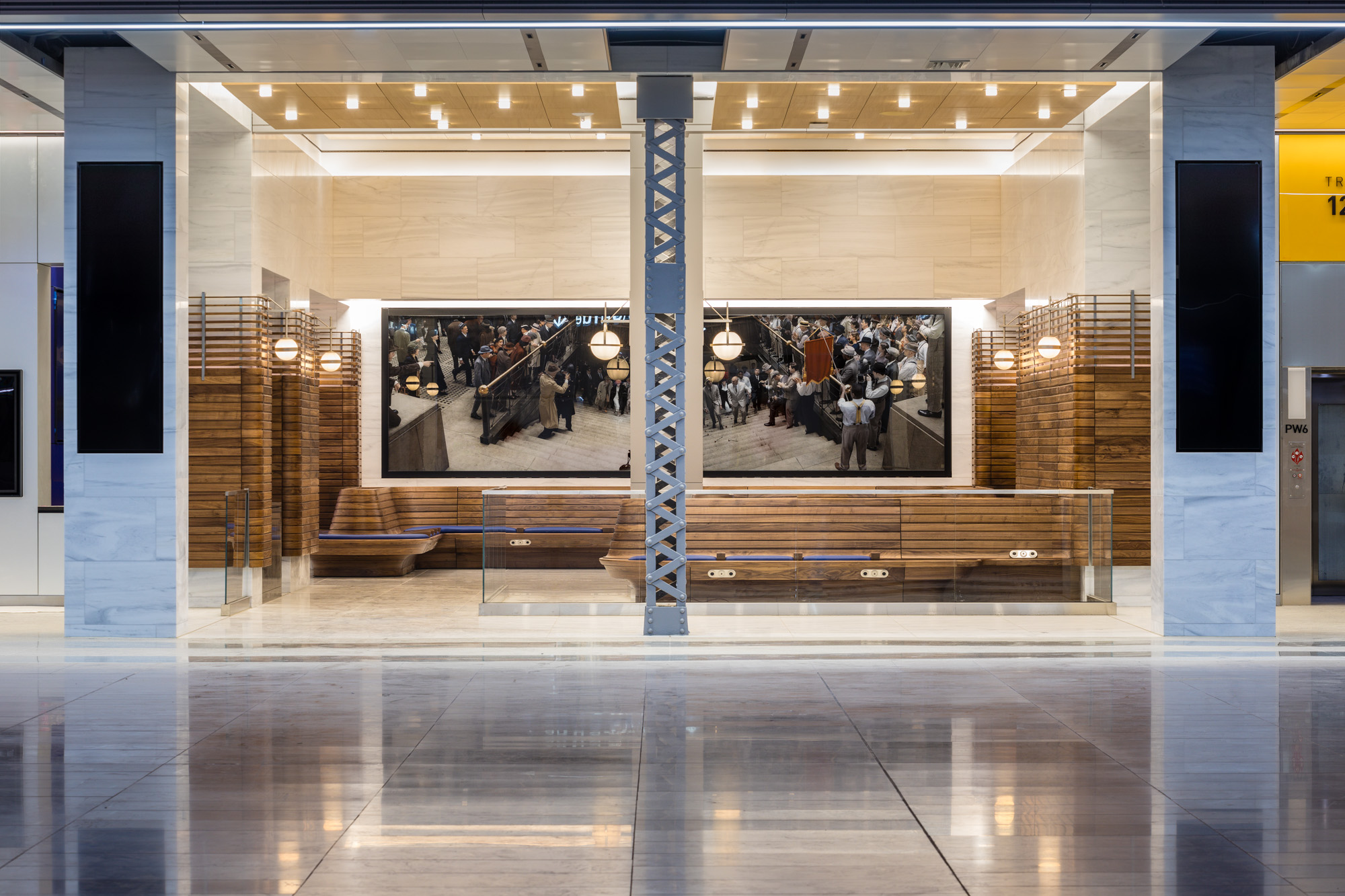
- About Penn Station’s Half Century: The artist’s first public art installation in New York, this series of nine photographic panels on view in the Amtrak Ticketed Waiting Area recreates serendipitous and poignant moments from the history of the original Penn Station (1910–1963). The artist mined thousands of articles for little-known stories of Penn Station and then staged hundreds of photographs featuring 400 costumed performers. He used CGI technology to compose the final images within a remarkably realistic model of the original historic station.
- About Stan Douglas: Based in Vancouver, British Columbia, Douglas employs photography, film, and theater to reconsider history and the means of its documentation.
- Behind the Scenes: Public Art Fund collaborated with Douglas to realize his vision of printing the images directly on glass panels. Public Art Fund collaborated with fabricators and worked with Moynihan’s architects to finalize designs, manage production timelines and ensure on-time delivery. The final glass panels were installed in four niches in the terminal’s ticketed waiting room.
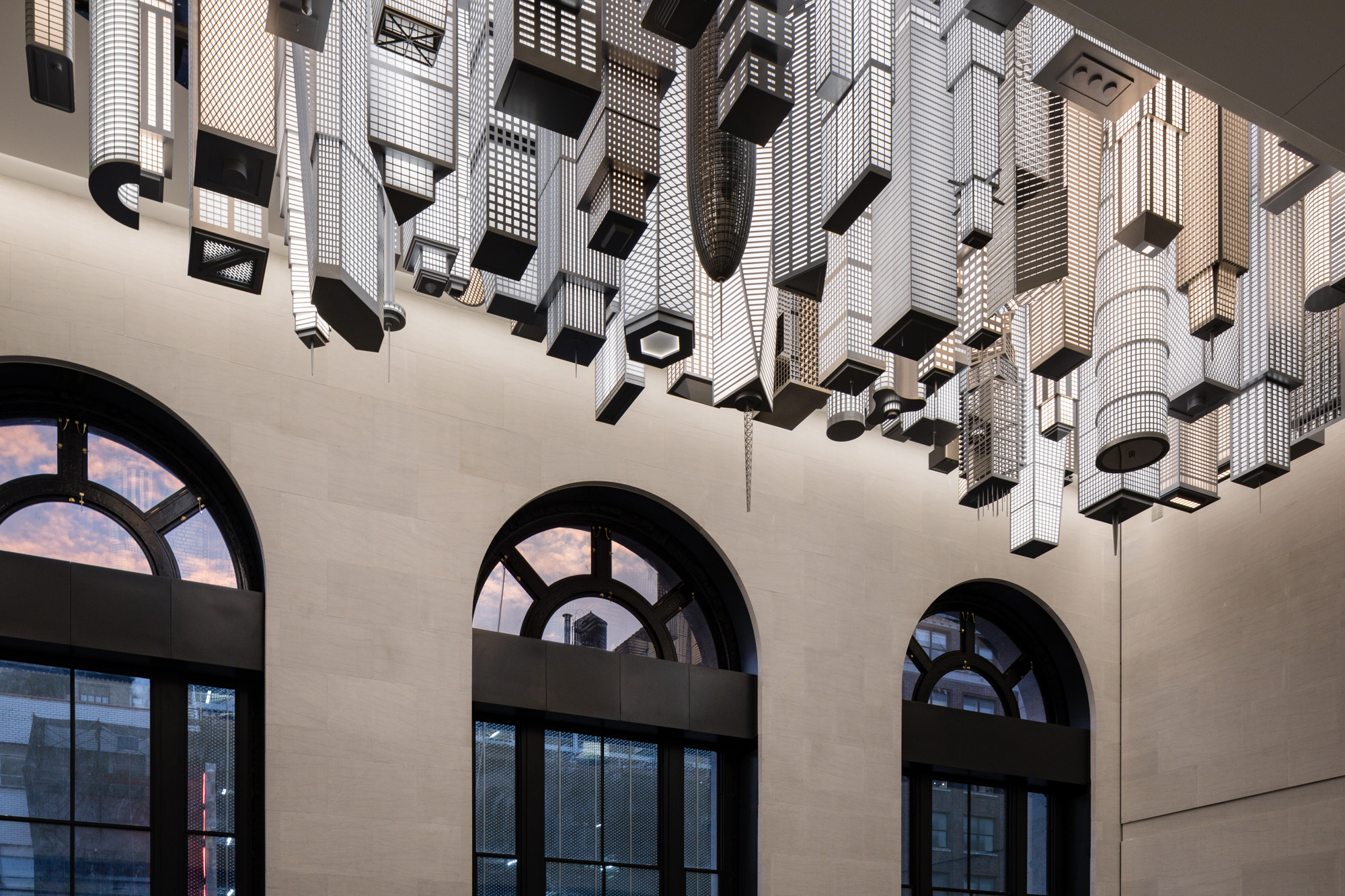
- About The Hive: Elmgreen & Dragset’s fantastical inverted cityscape references iconic buildings in New York City and other cities around the world, celebrating the new perspectives and interconnectedness that travel provides. Spanning across an 80-foot-long ceiling, The Hive is composed of 91 buildings that weigh a total of more than 30,000 lbs, with buildings up to 9 feet tall and integrating over .8 miles (1.3km) of LED strip.
- About Elmgreen & Dragset: The Berlin-based artistic duo create sculptures and installations that inspire novel perspectives on the objects and structures of our daily lives.
- Behind the Scenes: Public Art Fund worked in collaboration with the artists and Moynihan architects to develop the suspended installation and ensure safety, design, and full ceiling integration. Production took place across multiple countries, coordinated by Public Art Fund.
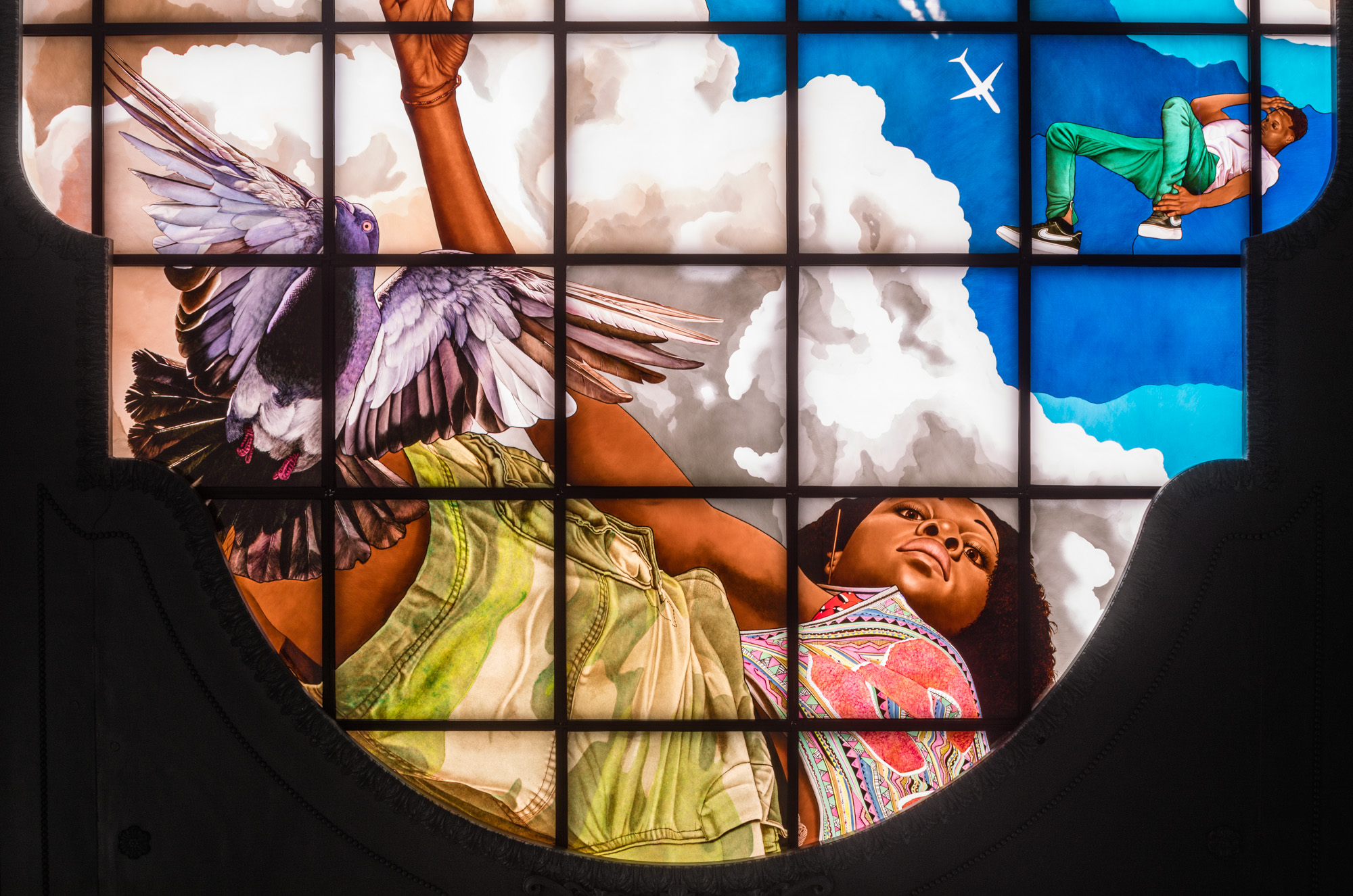
- About Go: Evoking the grandeur of decorative Renaissance and Baroque painting, the hand painted, stained-glass triptych features young Black New Yorkers in poses borrowed from breakdance, inhabiting a surrealist dreamscape of buoyancy, possibility, and survival.
- About Kehinde Wiley: Based in New York and Dakar, Wiley has gained recognition for highly naturalistic paintings of Black and brown people in poses and formats drawn from the Western art historical canon, which underscore the historical exclusion of people of color.
- Behind the Scenes: The stained-glass was produced in the Czech Republic. Fabricated in New York, the molding around the three glass panels was designed to coordinate with the metal framing exterior windows. The backlit skylight was developed to fit seamlessly into the architecture, which Public Art Fund integrated with the base building design and managed alongside Moynihan’s team and the fabricator.
Testimonials
“This significant project transformed a century-old building into a modern gateway that expands Penn Station and significantly enhances the traveler experience.” — Governor Kathy Hochul
“One of the most remarkable things about this project is the way that it transforms an under-utilized and under-appreciated building into a new, inviting front door for this city.” — Skidmore, Owings & Merrill Design Partner Roger Duffy
Moynihan Train Hall “delivers on its promise, giving the city the uplifting gateway it deserves…The transformation now is stunning.”
— New York Times architecture critic Michael Kimmelman
“The addition of work by well-known artists adds a celebratory vibe, a sense of pride in the public sphere.”
— Dionne Searcey, The New York Times