Nina Chanel Abney: San Juan Heal - Public Art Fund
বাংলা (Bengali) 简体中文 (Chinese Simplified) 繁體中文 (Chinese Traditional) Nederlands (Dutch) English Français (French) Deutsch (German) Italiano (Italian) 日本語 (Japanese) 한국어 (Korean) Português (Portuguese - Brazil) Русский (Russian) Español (Spanish) Xitsonga (Tsonga) Tiếng Việt (Vietnamese)
I am looking for…
Suggested searches:
Ai Weiwei
Talks
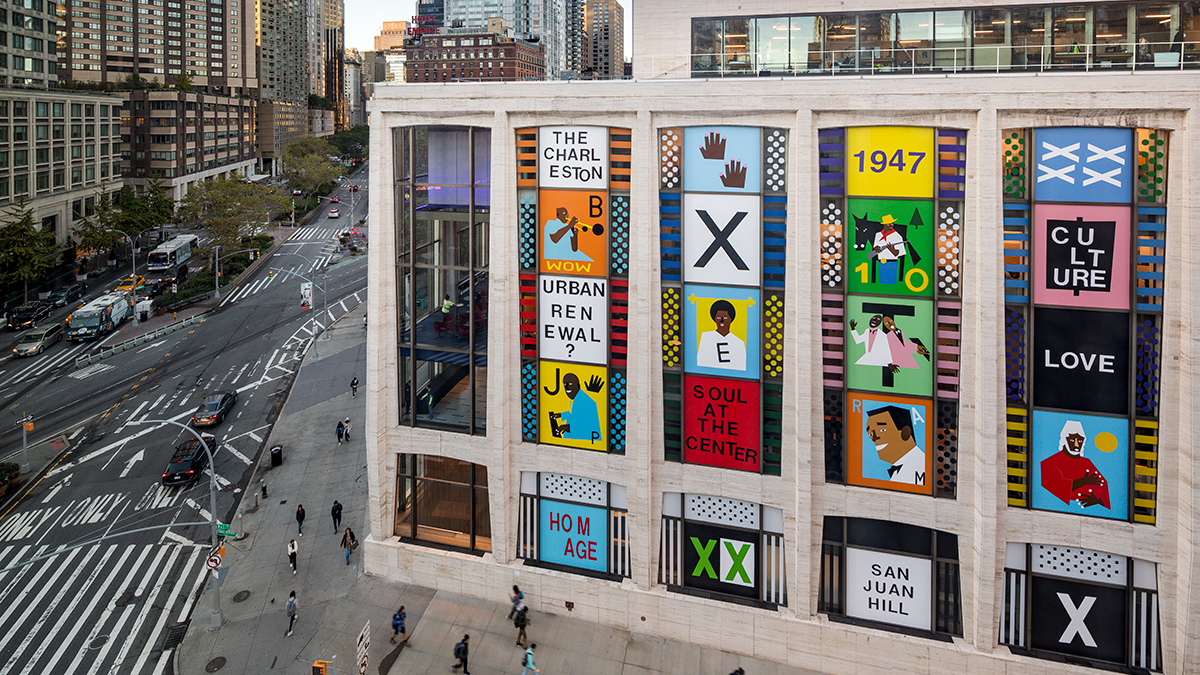
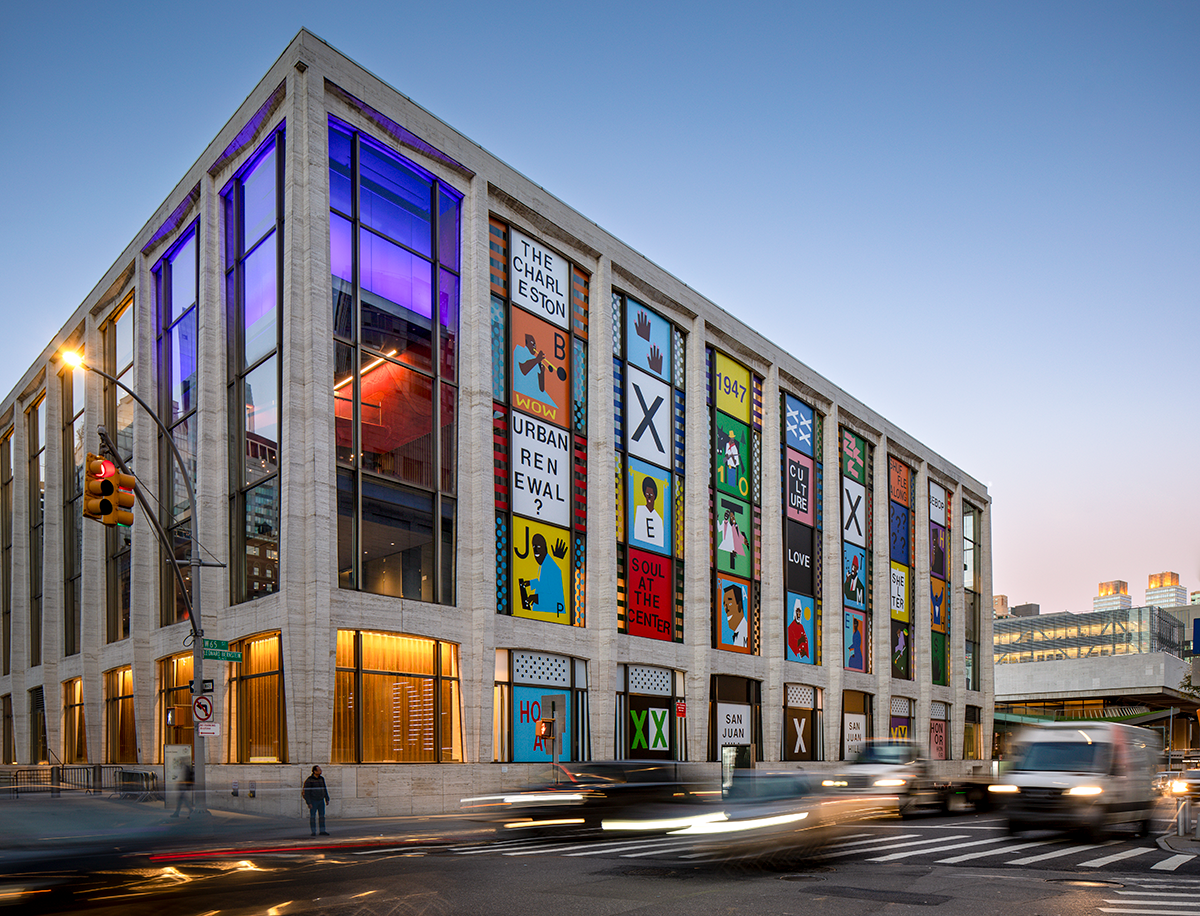
A composition of colorful, graphic portraits of significant San Juan Hill figures and historical references on the façade of a rectangular music hall in a bustling...

Nina Chanel Abney San Juan Heal

Lincoln Center
Through April 30, 2026

About the Exhibition

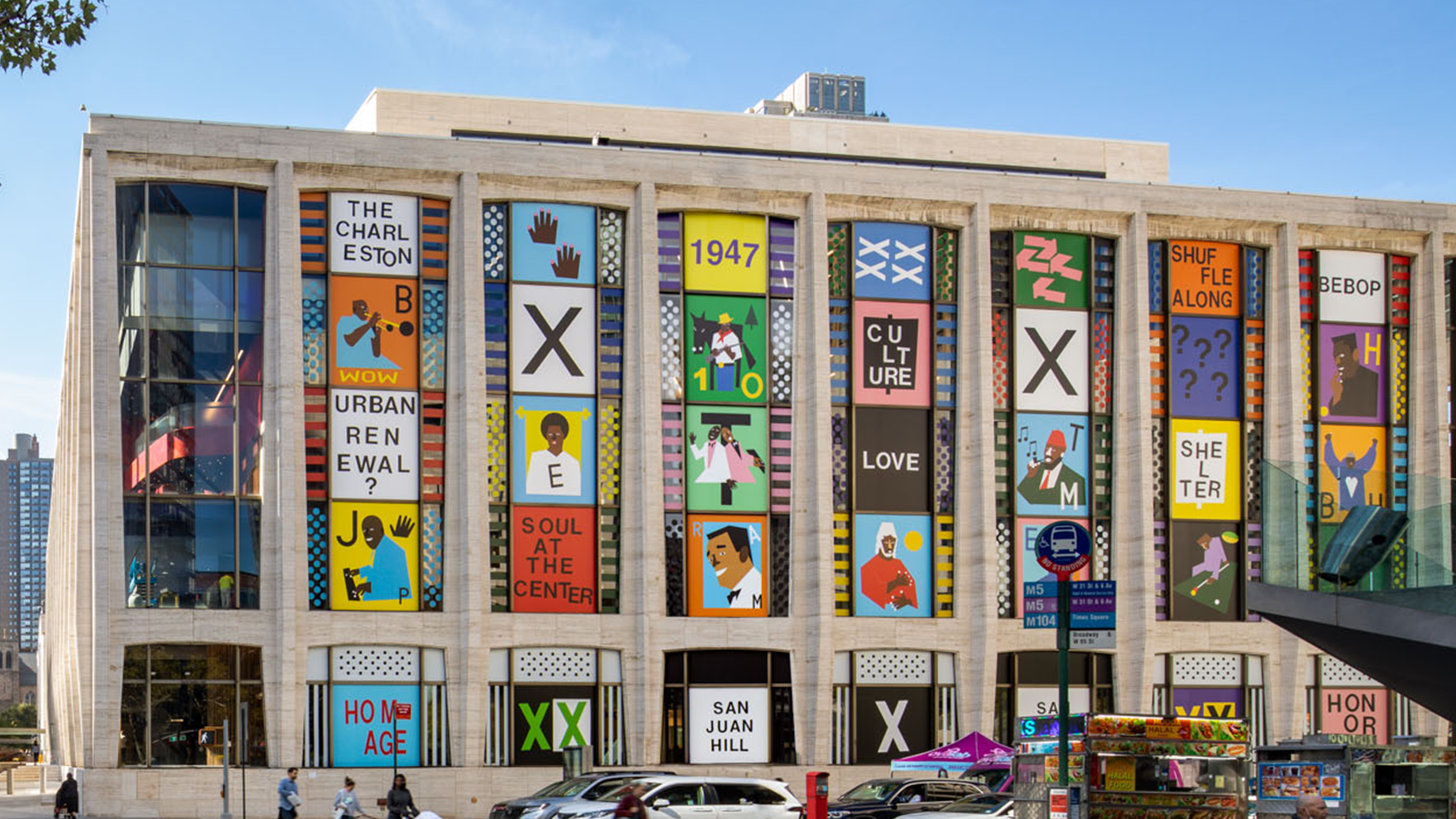
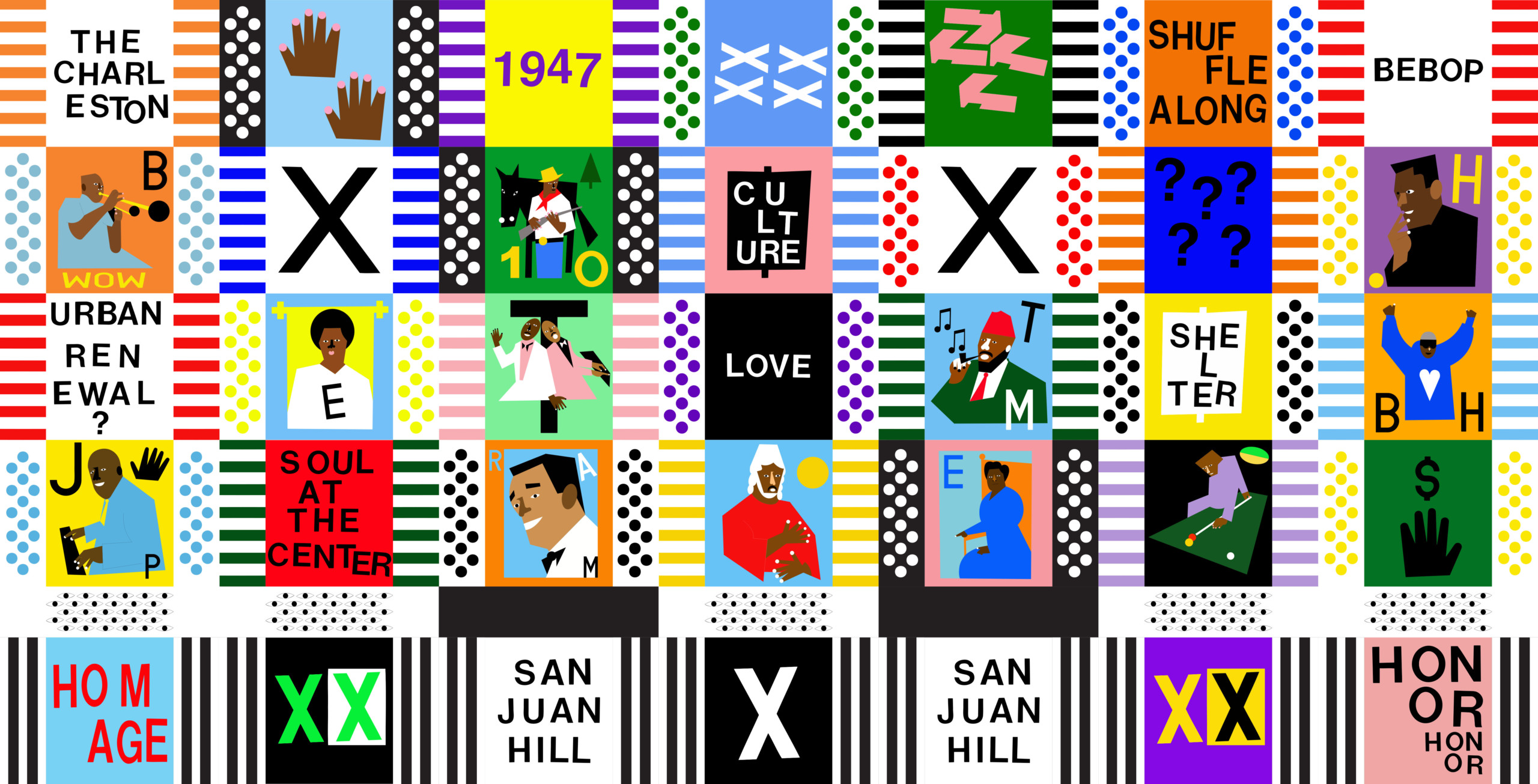
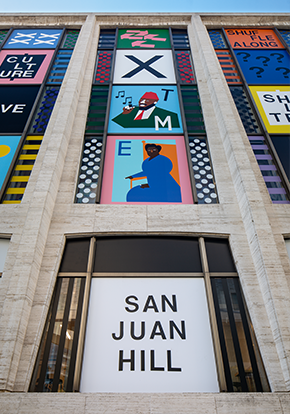
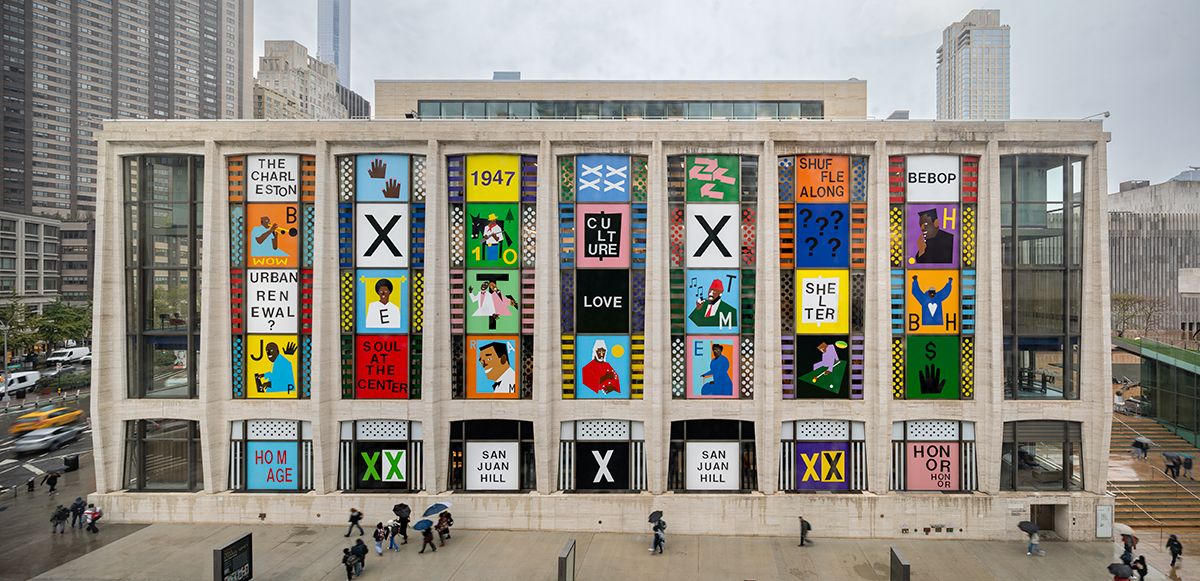
Nina Chanel Abney’s monumental work of art for the facade of David Geffen Hall, entitled San Juan Heal, pays homage to San Juan Hill. In the 1940s and ’50s, this predominantly Black and Brown neighborhood was forcibly displaced to make way for redevelopment, including what would become Lincoln Center for the Performing Arts. Abney’s constellation of figures, words, shapes, and symbols reflects the thriving community that lived here. Featured residents include pioneering health care workers Edith Carter and Elizabeth Tyler. Also pictured are James P. Johnson, whose music gave rise to the Charleston dance craze, and Thelonious Monk, a pioneer of bebop and other jazz styles. Reclaiming this important history in her bold and vibrant style, Abney aims to spark curiosity and inspire a more inclusive future.

Installation Photos

A colorful graphic artwork made up of a grid of significant San Juan Hill figures and historical references.
A composition of colorful, graphic portraits of significant San Juan Hill figures and historical references on the façade of a rectangular music hall in a bustling...
A close-up of the facade of a music hall building with a composition of colorful, graphic portraits of significant San Juan Hill figures and historical references.
Abney-3388
Abney-3577

Click on the image below, then hover over each small “i” circle to learn more about the historical figures and symbols depicted in Abney’s artwork.

Benny Carter (1907–2003) grew up in San Juan Hill to become a pioneering bandleader and jazzman whose musical talents were unparalleled. He played the saxophone, trumpet, clarinet, and piano and is widely celebrated as an "Architect of the Swing Era sound." He was one of first African Americans to arrange and write music for movies and television, such as the classic musical Stormy Weather (1943), and Sidney Poitier’s Buck and the Preacher (1972), as well as the police procedural M Squad, where he helped create the archetypal "detective jazz" sound featured in other crime dramas of that era. In 1996 his suite Echoes of San Juan Hill, a musical homage to the neighborhood, had its premiere with the Jazz at Lincoln Center Orchestra.
Black American soldiers were deployed in the 1898 Spanish American War that took place in Cuba, fighting both on foot and mounted on horseback. Two battles in an area known as San Juan Heights—the battle of San Juan Hill and the battle of Kettle Hill—were considered among the most decisive battles of the war. The all-Black 10th Cavalry and 24th Infantry fought in these engagements and were considered key to the victories. In 1909, 634 members of the 10th Cavalry were honored in a nine-mile parade through New York City coordinated by a Black civic group. While there is no unilateral agreement about why San Juan Hill was so named, a July 27, 1909, write up in The New York Times about this well-attended parade mentioned the neighborhood bearing the same name as their famous battles, one of earliest instances this neighborhood name occurred in print.
A San Juan Hill native, Herbie Nichols (1919–1963) was a jazz musician and composer, who started playing piano at the age of nine. A highly eclectic and imaginative artist, Nichols created a new complex sound by mixing Dixieland, swing, West Indian folk, and European classical harmonies. His compositions were humorous, thematic, and daring, often incorporating rhythmic displacements and extending beyond the limits of song form. A prolific artist, he composed about 170 songs, and recorded four albums between 1955 and 1957. Although responsible for composing notable tunes such as “Lady Sings the Blues” with Billie Holiday, his originality went largely overlooked during his lifetime. Fatally stricken by leukemia at age 44, his career was tragically cut short; in the years following his death his body of work garnered a cult following that continues to honor his legacy.
Elizabeth Tyler was the first African American nurse to be hired by the Henry Street Settlement (a social service agency founded in 1893 in Lower Manhattan), at a time when it was extremely rare for women of color to receive medical education. White patients refused to be treated by her and white medical professionals didn’t provide care in San Juan Hill, so in the early 1900s she, along with nurses Edith Carter and Jessie Sleet Scales, started their own initiative, the Stillman House Settlement, with the support of Lillian Wald. This facility not only provided treatment for Black and Brown patients suffering from tuberculosis, paralysis, and other illnesses, but provided social services for the community, such as banking, educational courses, and recreational activities.
The songwriting duo Noble Sissle (1889–1975) and Eubie Blake (1887–1983) created the score for the musical Shuffle Along, which premiered at 63rd Street Music Hall in San Juan Hill in 1921. It was the biggest hit of the season and became known as a rite of passage for several African American performing arts legends, such as Josephine Baker and Paul Robeson. Sissle and Blake’s work was included in Lincoln Center’s 2005 American Songbook program “At Harlem’s Heights,” which paid homage to jazz music composed by black artists from San Juan Hill and greater Harlem.
Thelonious Monk (1917–1982) grew up in San Juan Hill and became a renowned jazz pianist with a unique improvisational style. He was widely regarded as a founding father of jazz and credited with musical innovations that led to a new style of jazz known as bebop. Jazz at Lincoln Center held an annual Thelonious Monk festival for several years, paying tribute to the music legend.
A San Juan Hill native, Barbara Hillary (1931–2019) was a trailblazing adventurer best known for being the first African American woman to reach both the North and South poles, at ages 75 and 79. She was also a dedicated community activist and founder of The Peninsula Magazine, a multiracial publication.
The family of James P. Johnson (1894–1955) moved from Jersey City to San Juan Hill when he was 14 years old. His big hit was “The Charleston,” a jazz composition to accompany the Charleston dance, which debuted in his Broadway play Runnin’ Wild. Johnson was the foremost proponent of Harlem Stride piano, which combined the styles of boogie-woogie and ragtime.
Rogelio Ramirez (1913–1994) traveled with his family from Puerto Rico to Manhattan via Ellis Island in 1920, settling in the San Juan Hill neighborhood. Ramirez was an accomplished pianist in the genres of swing, bop, and jazz. He co-composed the jazz standard "Lover Man (Oh, Where Can You Be)", which was popularized by Billie Holiday, and interpreted by Duke Ellington, Ella Fitzgerald, Sarah Vaughn, and others.
Edith Carter was one of the first African American nurses to provide primary maternal and infant care in New York City. In the early 1900s, Carter, along with nurses Elizabeth Tyler and Jessie Sleet Scales, started an initiative in San Juan Hill called the Stillman House Settlement (which later became the Lincoln House Settlement). There they provided health care and social services to the Black community, who were refused treatment by white doctors and nurses.
In 1923, James P. Johnson’s Broadway musical Runnin’ Wild took the stage at the New Colonial Theater in San Juan Hill. It featured Johnson’s hit composition "The Charleston". The Charleston dance draws roots from styles of West African movement retraced by African Americans in the US South. It was popularized from San Juan Hill in New York and then won recognition worldwide. The dance gestures towards flow and cultural exchange. Residents of San Juan Hill came from the South, other parts of the US, and the Caribbean. From San Juan Hill they went to other parts of the United States, back to the Caribbean, and elsewhere. Black performers went to Europe when they found their access to American stages decreased as the Charleston, ragtime, stride, and swing faded, and as their neighborhoods changed. The Charleston welcomed all people across continents with both hands.
For many, the completion of the Amsterdam Houses in 1947 marked what some had long known—San Juan Hill as it once was, was no more. The numerous high-rise towers of the housing complex span from 61st Street to 64th Street between Amsterdam Avenue and West End Avenue—almost the entire tract of land where the modest tenements of San Juan Hill once stood. About 1,000 San Juan Hill residents still living in the area in the beginning of 1941 were warned to vacate their premises by July 1, when construction was set to begin. Though the new housing was intended to provide shelter to over 1,100 families once finished, most Black San Juan Hill residents who left the area did not return.
The 1956 Lincoln Square Development Plan set forward a plan for the City of New York to acquire an L-shaped mass of land and property for redevelopment. This graphic repeats that shape. Most of this land was considered Lincoln Square, as San Juan Hill was neatly excluded from the oddly outlined area because most of San Juan Hill had just been redeveloped to make way for the Amsterdam Houses. Still, fulfilling the Lincoln Square Development Plan meant that the churches, theaters, and businesses of Lincoln Square that overlapped with the culture of San Juan Hill were further lost and obscured.
Soul at the Center was the first major presentation of Black art and culture at Lincoln Center. Ellis Haizlip, an arts producer and TV host of the show Soul! curated the series along with radio deejay Gerry Bledsoe. Lincoln Center promotional materials describe the event as “a showcase of the finest Black artists from virtually every field of the arts.” In 1972, the two-week engagement in Philharmonic Hall and Alice Tully Hall featured musicians including Nina Simone, Donny Hathaway, Labelle, Cecil Taylor, and Carmen McRae. The series also included poets like Nikki Giovanni and Felipe Luciano, and dancers like Diana Ramos and the George Faison Universal Dance Experience as well as a fashion show and display of visual art. The following year, the series returned as Soul ‘73 and brought back performers from the first year as well as a range of new acts including Sister Sledge, The Spinners, Tina Turner, and many others.
Black saints were depicted in many Black churches that moved into the area in the 1880s and '90s, including St. Mark's Methodist Episcopal, Mt. Olivet Baptist, and St. Benedict the Moor Church.
San Juan Hill was home to lively entertainment venues, such as the famous jazz club Jungles Casino, as well as tenement basement clubs, poolrooms, saloons, cabarets, and dance halls.
A colorful graphic artwork made up of a grid of significant San Juan Hill figures and historical references.

About the Artist

Nina Chanel Abney    View Profile

Nina Chanel Abney is known for combining representation and abstraction. Her paintings capture the frenetic pace of contemporary culture. Broaching subjects as diverse as race, celebrity, religion, politics, sex, and art history, her works eschew linear storytelling in lieu of disjointed narratives. The effect is information overload, balanced with a kind of spontaneous order, where time and space are compressed and identity is interchangeable. Her distinctively bold style harnesses the flux and simultaneity that have come to define life in the 21st century. Through a bracing use of color and unapologetic scale, Abney’s canvases propose a new type of history painting, one grounded in the barrage of everyday events and funneled through the velocity of the internet.

Abney’s work is included in collections around the world, including the Brooklyn Museum, The Rubell Family Collection, Bronx Museum, and the Burger Collection, Hong Kong. Her first solo museum exhibition, Nina Chanel Abney: Royal Flush, curated by Marshall Price, was presented in 2017 at the Nasher Museum of Art, North Carolina. It traveled to the Chicago Cultural Center and then to Los Angeles, where it was jointly presented by the Institute of Contemporary Art, Los Angeles, and the California African American Museum. The final venue for the exhibition was the Neuberger Museum of Art, Purchase College, State University of New York.

(as of 2022)

About Creative Partnerships and Lincoln Center

Extending our core mission to present dynamic exhibitions by the world’s most compelling artists and make culture accessible to all, Public Art Fund: Creative Partnerships brings strategic planning, curatorial, project management, and communications expertise to leading cultural institutions, corporations, and civic organizations across the globe. Through these collaborations, Public Art Fund commissions permanent installations and temporary exhibitions in line with the unique vision of our partners and the specific parameters of each site, resulting in new artworks that activate public spaces, create engaged constituencies, and amplify the impact of our partners’ own initiatives through the power of public art.

Lincoln Center for the Performing Arts invited Public Art Fund in partnership with The Studio Museum in Harlem to launch a rotating series of commissions for the new David Geffen Hall’s public spaces. The Hall’s 65th Street facade was identified as a prominent site for a site-specific commissions, which Nina Chanel Abney has transformed into a captivating tribute to the vibrant history and culture of San Juan Hill.

The artwork is commissioned by Lincoln Center for the Performing Arts in collaboration with The Studio Museum in Harlem and Public Art Fund.


Related Exhibitions