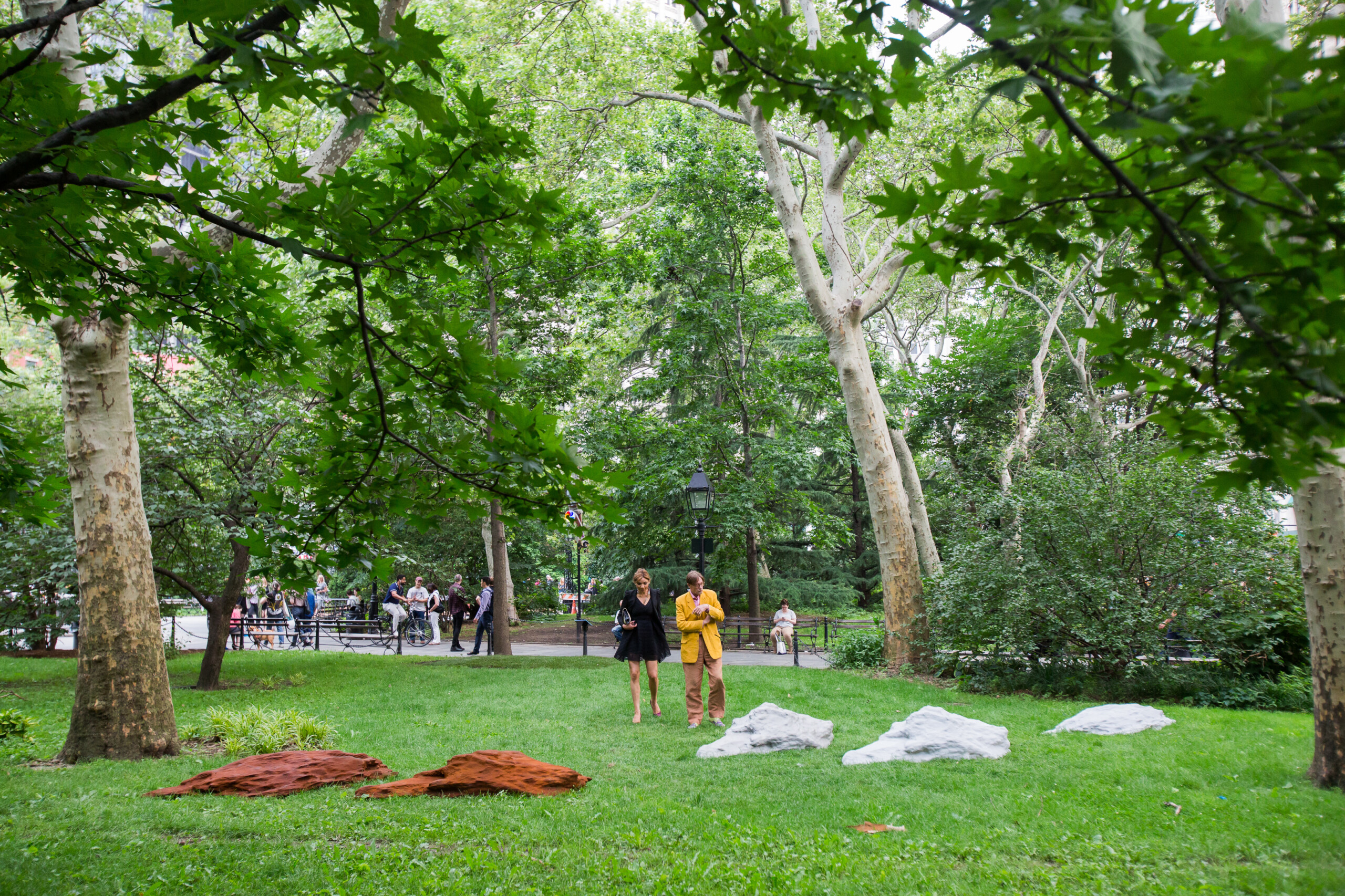
Alice Channer, R O C K F A L L (2015)
To create the seven sculptures that make up R O C K F A L L (2015), the artist digitally scanned a piece of concrete rubble and used computer software to stretch the 3D image and enlarge the cast “rocks” in concrete, aluminum, and Corten steel. Though lifelike, the resulting forms are entirely machine-made, with the evidence of the digital carving mechanism revealed on the rippled surface of each sculpture.
Lothar Hempel, FROZEN (2015)
FROZEN (2015) reflects Hempel’s interest in the effect of time on memory and image culture. The image of the skateboarding woman depicted on the sculpture suspended at tree-level appears to have been taken in the 1970s, yet it was appropriated from a contemporary online source. Paired with the familiar spinning rainbow wheel that indicates a computer error, the work questions the evolving nature of memory in our technologically mediated environment. Can a memory be frozen in time by the camera, our consciousness, or even digital delay? How long will it persist?
Jon Rafman, (Curveman Carrara) and (Elegante Carrara), 2015
In the series “New Age Demanded,” which includes (Curveman Carrara) and (Elegante Carrara), 2015, Rafman has digitally manipulated the form of a traditional Greco-Roman bust. To make each of these sculptures, Rafman first created a virtual version of a bust and digitally distorted its form. In the past, marble busts were carved exclusively by hand, but Rafman has utilized a computerized industrial tool to carve these forms, disguising the familiar shape of the figure with his own digital design. Focused on the virtual realm, Rafman highlights the paradoxes of modern life by weaving together classical elements with modern technology in pieces that are at once monumental and faceless, familiar and alien.
Amanda Ross-Ho, The Character and Shape of Illuminated Things (facial recognition), 2015
The Character and Shape of Illuminated Things (facial recognition), 2015, is a three-dimensional tableau replicating an image appropriated from an early photography manual. A twist on a previous sculpture by the artist, this version continues an exploration of photography, reflecting on the digital afterlife of art in the public realm. The central form of the tableau is a female mannequin, whose features inadvertently activate the facial recognition software ubiquitous to our social networks. Acknowledging the “intelligence” of the camera lens, Ross-Ho includes a neon square against the mannequin’s face, calling attention to this virtual framing device.
Hank Willis Thomas, Liberty (2015)
Liberty (2015) is a life-size, candy-coated bronze sculpture derived from a 1986 found photograph of a Harlem Globetrotter. He spins a basketball on his finger, in the likeness of the Statue of Liberty, which is featured in the background of the image. In a digital era where electronic devices mediate our viewing experiences, the three-dimensional arm, appropriated from the photograph, invites the viewer to consider the framing and context of the images that surround us.
Timur Si-Qin, Monument to Exaptation
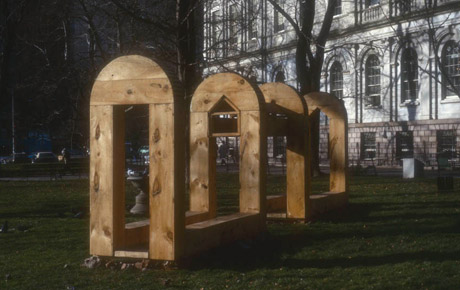
The title of the work, Monument to Exaptation, refers to an evolutionary shift, one Timur Si-Qin likens to changes in our behavior toward image culture and branding in the digital era. These three sculptures appropriate the form of an archetypal advertising space—one that might be placed at the entrance to a strip mall or car dealership—and their concave shapes intentionally allows the eye to linger few seconds longer on the surface of the image. These contemporary totems are displayed in City Hall Park in an almost ceremonial fashion, depicting several iterations of Si-Qin’s signature logo for peace. Rather than serving as a platform for advertising, the objects function like a future monument to the visual landscape of today.
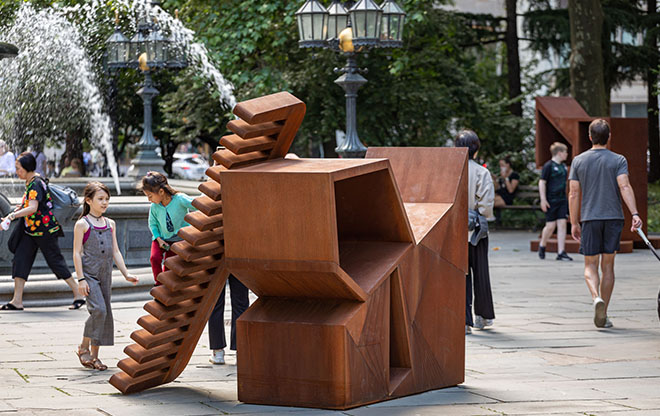
Artie Vierkant, Image-Objects
Artie Vierkant’s sculptures, digital art, and videos explore the nature of intellectual property, commercialism, and online distribution. In his “Image-Objects” series—from which the exhibition draws its title—he reworks photographs of his exhibitions, turning the physical objects into digital images in an exploration of the transformation and reproducibility of digital images.
Each piece begins its life as a digital file named for the date and time of its source image; these are then rendered as prints on Dibond and cut to create photographic images that approach the depth and presence of a sculpture. Each time the pieces are officially documented, the new images are altered to create a version of the work that moves further and further away from a representation of the original physical object. This new Image Object—Vierkant’s first outdoor work—translates the photographic process into three-dimensional form by printing digitally altered images directly on a large cut-steel cube. The visual gaps between the form and the printed images explore the flexibility of perception and vision. This is particularly true in Vierkant’s post-opening intervention to the documentation images of work, which are disseminated to press and on the Public Art Fund website, along with images captured by viewers throughout the course of the show.