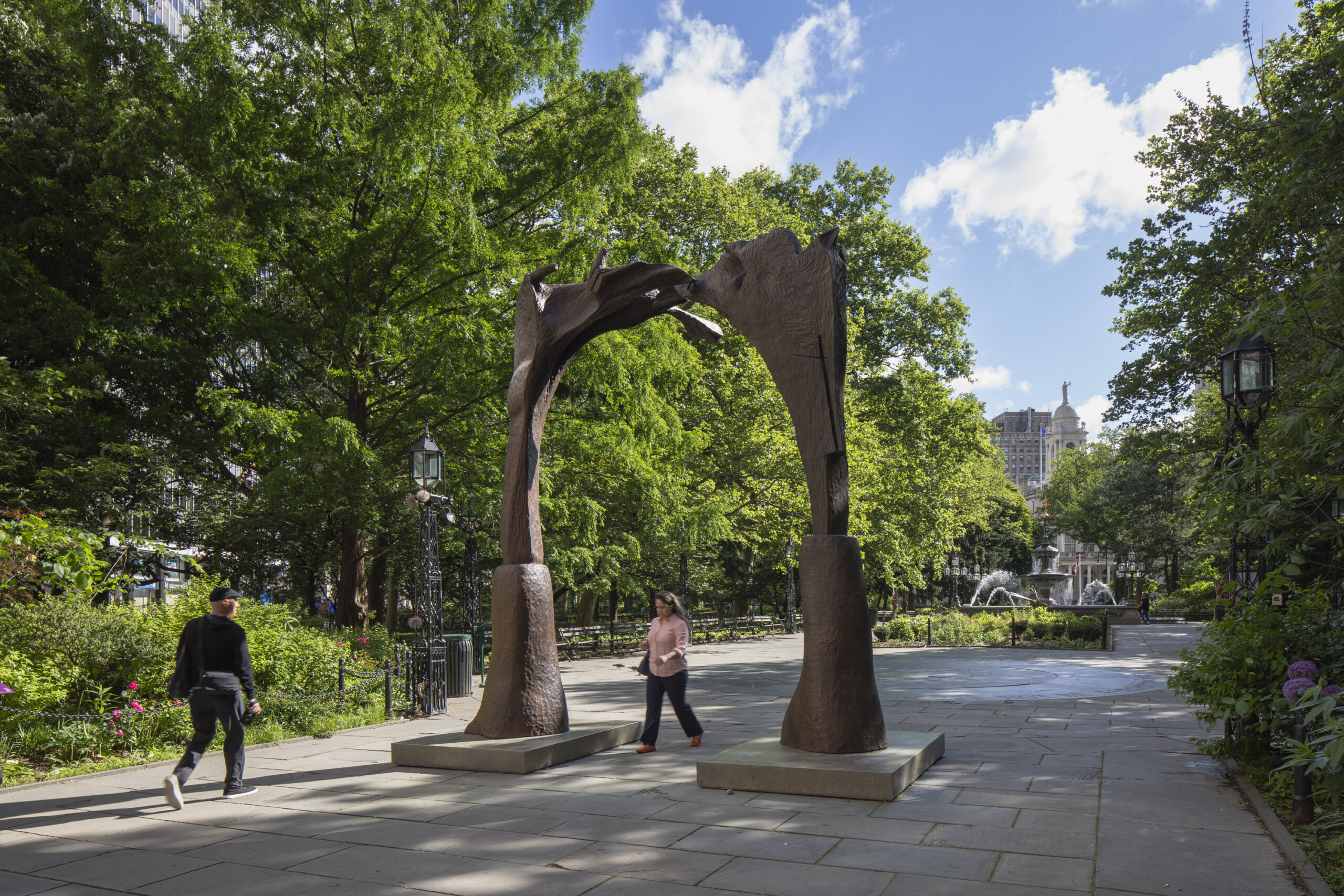
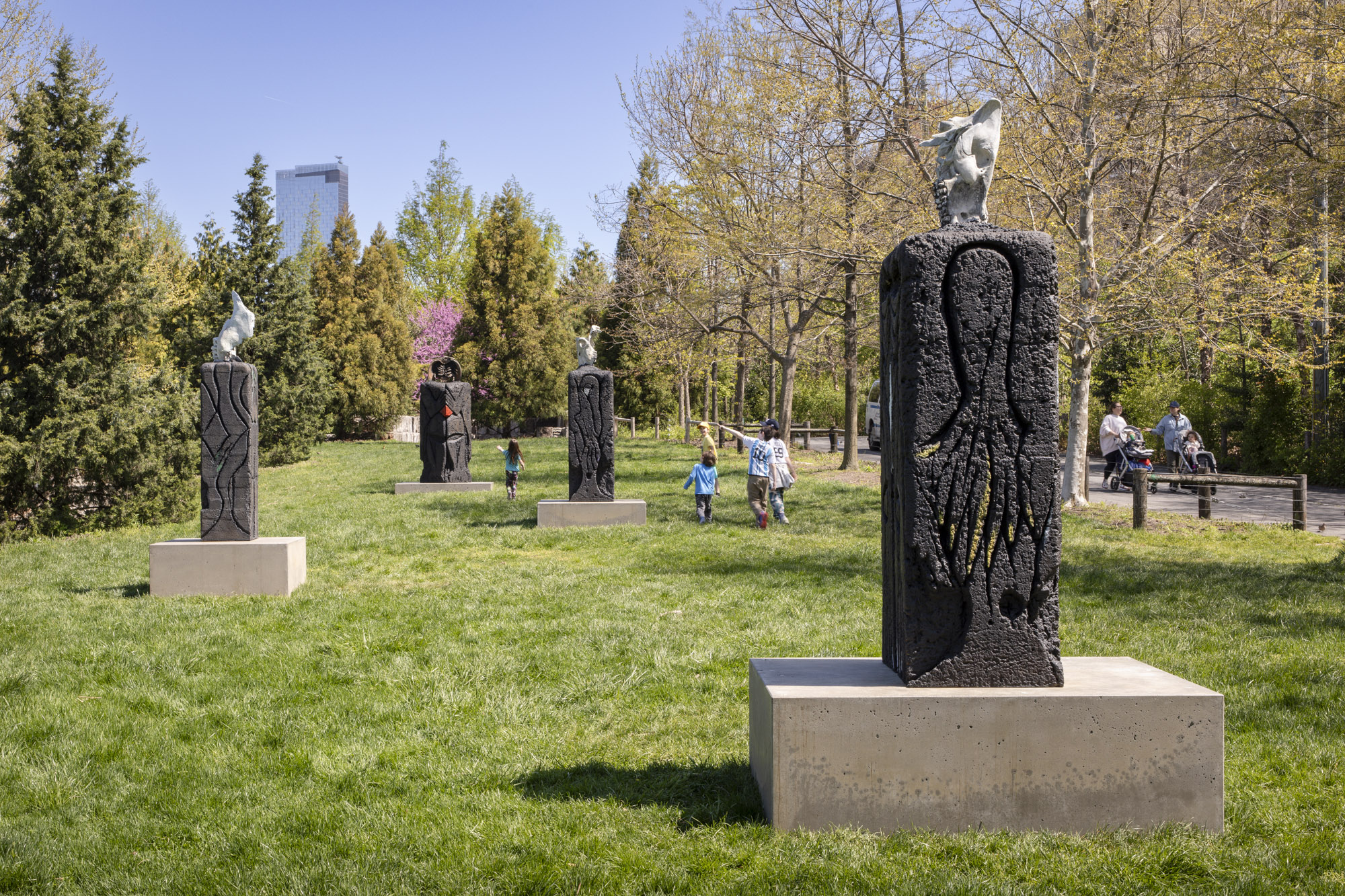
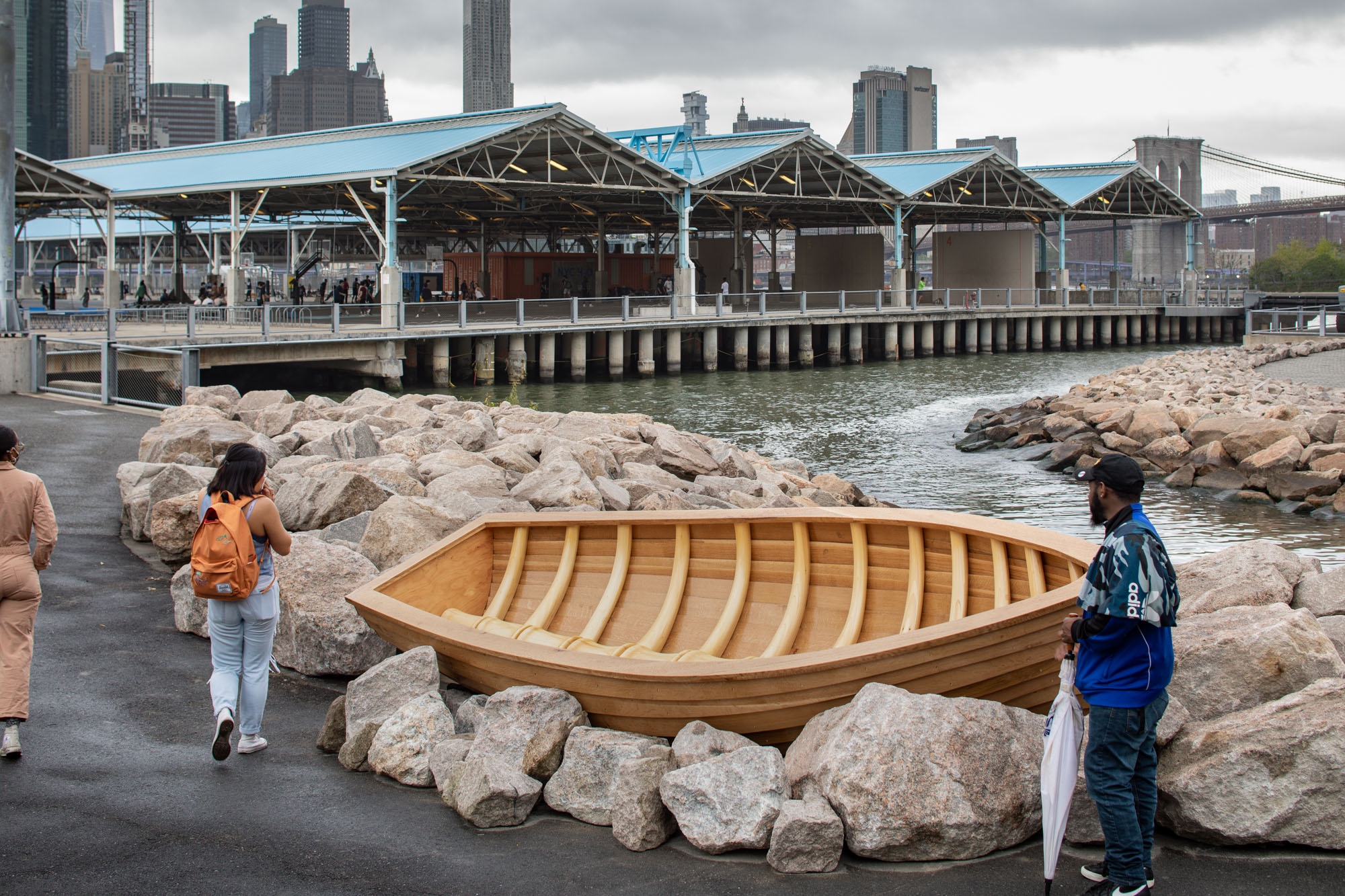
Danh Vo’s exhibition We the People brings together may pieces from his segmented replica of the Statue of Liberty, alongside a new horticultural work created especially for this exhibition. The information below sheds light on the significance of different parts of the figure and the composition of the statue, as well as the making of the garden.
Lady Liberty’s Drapery:
The drapery of the Statue of Liberty’s robe covers nearly 80% of the figure’s body. There are 23 pieces of this drapery on view as part of Danh Vo’s We The People at City Hall Park and Brooklyn Bridge Park. As with the original statue, the sculptural folds of fabric were rendered by pounding copper sheets over a cast of the statue to create each form.
The original statue’s sculptor, Frédéric Auguste Bartholdi (1834–1904), worked in the Neoclassical tradition and clothed Lady Liberty in elegant folds of drapery to evoke Greek and Roman antiquity and represent the classical legacy of Western politics. In terms of practical artistic concerns, drapery was also seen as a useful approach to figurative sculpture because it both concealed and revealed the physical attributes of the female body.
A Broken Chain:
At the feet of the Statue of Liberty on Ellis Island, there lies a broken chain that is partially concealed by the statue’s dress. There are many anecdotes about the reason for including the chain in the statue’s design. Some have said that it was a symbolic gesture of support for the anti-slavery movement in the United States at the time. Others have said that it was a general reference to freedom and the end of oppression as outlined in the Declaration of Independence.
There are replicas of four of the colossal chain links placed in the historic rotunda in the lobby of City Hall. Like the divergent stories of Lady Liberty’s chain, the history of the surrounding park is equally evocative. Prior to its current designation, it was the site of an almshouse, a jail, an African burial ground, and a union organizing commons. Historically it has represented a crossroads of power and oppression, hope and salvation. Here, the chain links symbolically connect a constellation of references to freedom and liberty that are buried within the site’s own history.
A Stacked Pedestal:
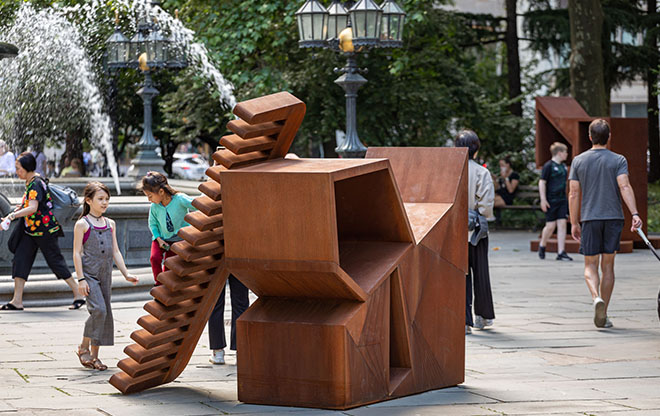
If assembled, the stack of flat copper sheets on view in City Hall Park would comprise a copy of the small rectangular pedestal at the foot of the Statue of Liberty. Since the original monument is structurally supported by its large stone pedestal, the copper plinth was incorporated into its design for aesthetic reasons, rather than out of architectural necessity.
In City Hall Park, Vo has stacked the sections of the plinth to create a new sculpture in reference to the original. Recalling similar forms by Minimalist sculptors who rejected the notion that a sculpture required a pedestal, Vo’s installation transforms monumental nature and symbolic value of the Statue of Liberty’s plinth. In doing so, he also subtly recontextualizes the pedestal and its function into a generic, minimal sculpture.
Rodgersia aesculifolia armandi, Rodgersia pinnata, Buddleja davidii, Clematis armandii, Clematis-forgesil, Osmanthus decorus, Osmanthus delavayi, Paeonia delavayi, Stachyurus chinensis, Rhododendrons racemosum, Rhododendrons irroralum, Rhododendrons ciliicalyx, Rhododendrons-calophytum, Rhododendron-discolor, Rhododendrons-moupinense, Rhododendrons-williamsianum “Andrea”, Rhododendrons-“danula”, Rhododendrons-augustini-“stoutette”, Primula forbesii, Primula rosea, Deutzia discolor, Deutzia purpurascens, Deutzia scabra, Aconitum tongolense, Aconitum delavayi, Aconitum lilijestrandii, Aconitum forrestii, Aconitum nutantiflorum, Anemone begonifolia, Anemone coelestina, Anemone trullifolia, Aster delavayi, Bashania fargesii, Buddleja myriantha, Catalpa ovale, Cerasus tomentosa, Cerasus tianshanica, Cerasus fruticosa, Clematis potaninii, Delphinium brunonianum, Delphinium forrestii, Delphinium smithianum, Delphinium yunnanense, Delphinium pseudotongolense, Delphinium Delavyi, Delphinium grandiflorum, Delphinium anthriscifolium, Delphinium trichophorum, Impatiens delavayi, Impatiens noli-tangere, Lilium souliei, Lilium henrici, Luzula rufescens, Luzula plumose, Nepeta prattii, Nepeta stewartiana, Nepeta coerulescens, Nepeta tenuiflora, Nepeta sibirica, Nepeta souliei, Osmanthus didymopetalus, Pinus densiflora, Populus rotundifolia, Rodgersia aesculifolia, Rodgersia henrici
This garden reflects Vo’s ongoing interest in the history of botany and the impact of colonialism through horticulture. The plants on view have been selected according to a list of flowers that were catalogued by French missionaries during their ministry work in Southern Asia in the late 19th century. The missionaries’ many discoveries are archived in the Musée National d’Histoire Naturelle, Paris. The plants selected for this garden—specifically, the rhododendrons—are descendants of the varieties that were introduced to Europe and North America by way of the missionaries’ research. Together, the names of the plants also comprise the title for the work. Like We The People, Vo’s garden addresses themes of cultural interchange and the residue of colonialism in contemporary life.